

"With a T140, you’ve got classic British biking with decent brakes and a generally good all-round ride.
I really can’t emphasise enough how much fun it’s been."
Malcolm Turner 1979 Triumph T140E Bonneville 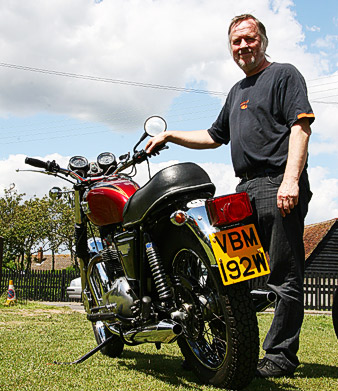
| " I bought my Triumph Bonneville from new from a firm called Acton Vale Motorcycles in West London. It cost about £1600. It’s still got very low mileage at just 21,000, and has had the top end rebuilt twice to cure oil leaks around the pushrod tubes. It’s on the original bore and original valve gear, etc. Much of the mileage was done on the continent. I’ve visited Germany, France, Norway, and all the countries in between. I went to Holland on a separate trip, always solo rides to club events mostly.Cruising at around 70-80mph seems to suit it okay. It hasn’t been converted for unleaded, incidentally, and I don’t use any other fuel additives. Just ordinary unleaded. It’s on the original chrome, and has the original paint on the frame –although I’ve had to dolly that up a little. I removed the carrier and blanked the holes and fitted aftermarket indicators. I've never much liked the look of the standard indicators. I’ve had other British bikes; a T150 Triumph Trident and some BSA A10s. And I also own a 500 BSA single and a Hinckley Bonneville. But I prefer the Meriden bike by far. I shall probably get rid of my Hinckley Bonnie after a trip to France this year. I do my own servicing. It’s simple enough and this bike hasn’t actually wanted very much. Aside from minor oil leaks at the top end, it’s pretty much oil-tight. Parts come from all over the place, but mostly TMS in Nottingham and Worsley Motorcycles. They’re all pretty good to deal with. I like the Bonnie gearbox. It’s never given any trouble. The clutch is okay. And the handling is very good. With a T140, you’ve got classic British biking with decent brakes and a generally good all-round ride. I really can’t emphasise enough how much fun it’s been." |
Martin Ashby 1978 Triumph T140V Bonneville 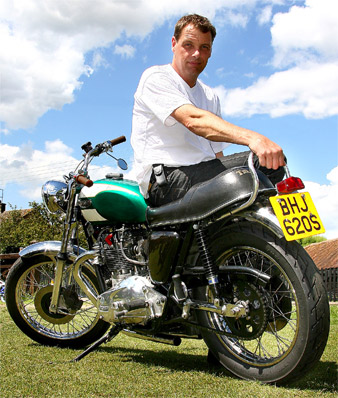
"I then discovered the damage;
7 of the 10 gears were broken. The bike was still changing gear up to that point (under a little protest) which is a testament to the Triumph. " | "I built this bike from parts. I’ve had the frame for 22 years and began assembling it 19 years ago. The engine and wheel hubs are Les Harris-era Bonnie; made after the Meriden plant closed. Which makes it a 1988 engine, or thereabouts. The original purchase price was £300 but the only part of that bike used was the frame; everything else has been bought or made since then. The modifications are numerous, including stainless steel rims and spokes, stainless steel mudguards, billet alloy slab-yokes, stainless steel handlebars, aluminium brackets, allloy grab-rail, cartridge oil filter, MkII Amal carbs (Harris engines usually have Mk one-and-a-half carbs), foam air filters, Norman Hyde valve gear, Norman Hyde oil-cooler, Norman Hyde rear-sets, stainless steel headlight mount, stainless steel head-steady, stainless steel pushrod tubes, LP Williams clutch conversion, Lockheed race master cylinder, braided brake lines, and all nuts and bolts made from stainless steel. The bike has been on the road for only 15 months after a full engine rebuild. After a year the gearbox developed a problem, though not to the extent of preventing a trip to France to see Canned Heat. Later I discovered phosphor bronze swarf in the oil, so I split the gearbox. I then discovered the damage; 7 of the 10 gears were broken. The bike was still changing gear up to that point (under a little protest) which is a testament to the Triumph. The damage was caused by the bore hole in which the cam plate sits. It hadn’t been bored to the correct depth at the time of manufacture. To remedy this, the engineers had cut down the cam plate shaft incorrectly, which in turn prevented the cam plate from aligning correctly with the index plunger—and as a consequence eventually wrecked the gear box. The only other problem I had was with a set of aftermarket stainless steel exhaust pipes that I had made which went on the bike when I first put it on the road last year. Because they were badly made (i.e. were not the right length and the bends were not parallel and were too extreme), it didn’t allow the bike to breath properly. This caused a lack of performance which was remedied by throwing them away and replacing them with the drag pipes they currently sport. Having raised the jets from .200 to .220 the bike now runs beautifully but possibly a little loud. Apart from the listed parts which were bought from Norman Hyde and Les Williams, and the wheels by Doug Richardson in Devon, the one-off pieces were made by my close friends Trash, Chuff, Graham and Nobbin although the inspiration for the bike comes from our friend in Devon, Kim, and his Bonneville. I now have a hydraulic clutch and the matching master cylinder to the hydraulic brake. An LCD speedo is on order and the next planned upgrade is the switchgear and a twin disc conversion. As well as France, I went to Devon last year with 2 Norton Commandos and a Guzzi, I use the bike all the time. I am really pleased with my Bonnie and can’t thank my friends enough for their invaluable help." |
Guy Fensome 1976 Triumph TR7 Tiger 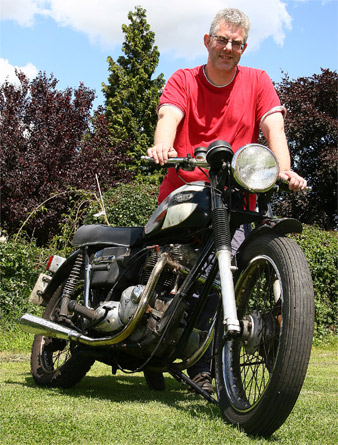
"When I got out of despatch
riding I kept the Triumph and
got rid of my other bikes. I’ve visited Belgium on this Tiger,
plus France, Italy, Wales and Ireland. It’s always been good,
if a little rough looking." | "I got my TR7 Tiger in 1985 and paid about £250. It was fairly rough. At the time, I was despatching on small Jap bikes and began using the Tiger instead. I was doing roughly 500 miles a week for 3-4 years. The bike was great throughout.It needed a new set of points every 3-4 months. Otherwise, it was just a question of changing oils. The gearbox oil can get a bit mayonnaise-ish, especially if you’re doing regular short runs. So I used to change the gearbox oil when I changed the engine oil. Aside from that and the tappets and chain, there wasn’t much else to do. It’s never been wonderfully oil-tight. I was told never to use gasket cement, and I’ve kept to that. The only time I had a top-end problem was when I was messing about with the timing and melted a piston. But that was a self-inflicted problem, not a fault of the bike. The wiring loom burnt out, but that was also my problem by badly routing it. I’ve never had a problem with the valves. It runs on unleaded, and the carb is an Amal Mk1. Drive chain life has been around 20,000-25000 miles. Tyres are now Avon Speedmaster at the front and a Dunlop K81 on the back, but I prefer Roadrunners. I get about 12,000 from a rear tyre and forever on the front. Taking the back wheel off is a pain. It can be a nuisance, especially if you’re on your own, but I’ve done it a few times. The single carb makes it more torquey than a standard T140. I rebuilt the engine once myself. Had the crank reground, fitted new mains, etc. Some years later, Andy at FD Motorcycles rebuilt it. FD Motorcycles are my local shop. It now has lower comp pistons (7.4:1 instead of 7.9:1 to one). It helps. But generally, I like to keep things standard. When I got out of despatch riding I kept the Triumph and got rid of my other bikes. I’ve visited Belgium on this Tiger, plus France, Italy, Wales and Ireland. It’s always been good, if a little rough looking. I really like British bikes, and I think 750 Triumphs are the most useable. The performance is good enough for modern traffic. It’s now just a pleasure bike. I don’t suppose I currently ride more than 2-3000 miles a year on it. I don’t know the mileage. I’ve been through about 5 speedos, so I haven’t a clue. A lot of the chrome became quite poor, so I blasted and painted the headlamp bowl. The bike never came with a rack. Riding two up on it was always okay. When abroad, I just take the usual cables, tubes, plugs, and enough spanners to take off both wheels and the petrol tank. There’s been no vibration damage. Cruising speed is anything from 55mph to 80mph – whatever the road needs. Never had the crank balanced. Vibes simply have never been too bad." |
Terry Cooper 1979 Triumph T140E 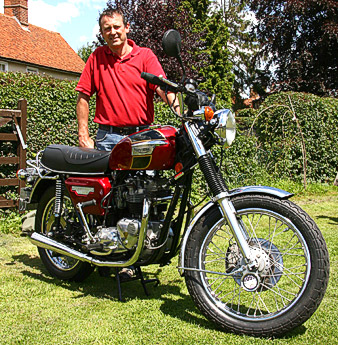
"It’s a good bike and has never let me down. It handles really well. The disc brakes give confidence, but the clutch was really heavy. So I bought a stainless steel Teflon coated clutch cable. It made a huge difference." | "I bought my T140 April 2000; a treat for my 50th birthday. It was built in March 79, but wasn’t registered until August 1980. I paid £3000 for it. It was in good condition. But the previous owner had fitted tassles and mudflaps and a king and queen which I removed. It ran well. The first problem was the rear master cylinder which seized; a known fault and easily fixed. I bought a new one from Worsley Motorcycles in the Midlands.The carburettors (Mk2s) played up after that. The little choke-piston rubber seals had perished, so I stripped the carbs and rebuilt them. This bike actually has an earlier Bonnie tank, but I liked it and kept it. It was painted in 1979 colours (candy apple red and black), but with a single pin stripe instead of the original two. It’s a good bike and has never let me down. It handles really well. The disc brakes give confidence, but the clutch was really heavy. So I bought a stainless steel Teflon coated clutch cable.
It made a huge difference. I replaced the silencers too. The bike had Dunstall megaphones and now has Norton Peashooters by Armours—which are really strong and well built and make a nice noise. I’ve also fitted a Norman Hyde fork brace and an aftermarket steering damper. The light switches are original. It should have eight inch high export bars. But it’s actually got lower bars. I use GTX Castrol with an aftermarket spin-on filter. It does vibrate a bit, and some days it seems worse than others. But it’s not that bad. The spokes are stainless steel spokes with chromes rims. It’s oil tight, except when it’s on the side stand having been running for a while. I’ve bought some Hyde mushroom tappets which I’ll fit sometime. The normal tappets indent the valve stem and make accurate adjustment difficult. It’s showing 21000 miles, which looks original. Starting is easy. Just free the clutch. Choke on. Kick it over twice with the ignition off. Then turn the ignition on, and it starts first kick. I would recommend the bike, and I’ve no plans to sell it. |
Tom Byrne 1979 Triumph T140E 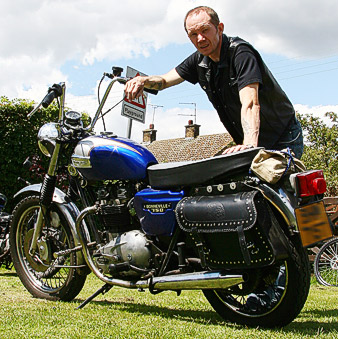
"I’ve got a Les Williams clutch kit which has an extra plate and lighter springs, and that seems to work fine too. The forks and rear suspension, however, are no more than adequate." | "I’ve had this bike for about 5 years. It had a home market tank, which I changed for US spec tank and had painted blue and silver. I’ve had to do the usual top-end oil pushrod seals, and a wire snapped on the ignition, probably from age embrittlement. There was enough loose wire in the headlight to pull out and trim and refit the connectors. My ignition switch is now under the tank. Those were the main problems, all of which were easily fixed. The leather pannier bag were an Ebay find. They cost £12.50 plus £10 for postage. Tyres are Avons, which are good all-rounders. The brakes are fine. I’ve got a Les Williams clutch kit which has an extra plate and lighter springs, and that seems to work fine too. The forks and rear suspension, however, are no more than adequate. It’s my first Bonnie, incidentally. I had a 500cc Triumph years ago, and wanted another Triumph. I’ve had Japanese bikes before too, but decided to go back to British bikes. I do servicing myself. Parts come from MCS in Leytonstone, East London. I get other stuff from the T140 shop in Newcastle. The man’s a perfect gentleman and more than once has sent parts ahead of a cheque. The exhausts are Norton peashooters. The standard T140 cigar shaped exhausts aren’t exactly pretty and are too long. And quiet. The handlebars are higher than standard. I think they’re called Spitfire ‘bars. They keep my speed down a bit but the standard cables all fitted. The bike is oil-tight except for the primary case where the outer cover meets the cases. A previous owner damaged it and I haven’t got around to getting a replacing case. There’s no rev-counter on my bike. Just a speedo. You need a rev-counter only when balancing the carbs, which are Mk2s and work fine. There are no indicators and no mirrors. They spoil the looks, even if it makes riding a bit more risky. I paid £2400 5-6 years ago (2003-2004) and intend to keep this bike." |
| 
Classic bikes for sale Check out our old bike market and treat yourself to a new AJS, Ariel, BSA, Greeves, Matchless, Norton, Velocette, Vincent or whatever. You're a long time dead. Live a little while you can...
T140 Bonneville & Triumph TR7 Tiger buyers guide 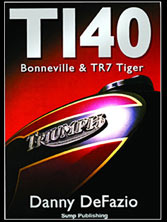
£9.99 plus P&P
CLASSIC BIKES
FOR SALE Check out our old bike market and treat yourself to a new AJS, Ariel, BSA, Greeves, Matchless, Norton, Velocette, Vincent or whatever. You're a long time dead. Live a little while you can...
CLASSIC BIKER
T-SHIRTS You ain't going out dressed like that, are you? Get into the right gear, man. Image is everything
CLASSIC BIKE WORKSHOP Technical problems & solutions
CLASSIC BIKE BARGAINS Everybody loves 'em, don't they?
BIKING VIDEOS Action, lights, cameras. We're celluloid bikers too, ya know
CLASSIC BIKE GUIDES Buying a classic motorcycle?
Get a few facts before you hear
a lot of fiction
MOTORCYCLE
SPECIALISTS Classic bike dealers, engineers, mechanics and experts
CLASSIC BIKERS Classic guys and girls like you
TANK SLAPPER Comment, viewpoint, opinion, etc
ARCHIVE The stuff we ought to throw out...
£14.99 
|
